Home > News > Blog > How to Select Clean Compressed Air Piping for Pharmaceutical Production
# Blog
How to Select Clean Compressed Air Piping for Pharmaceutical Production
2026-10-10
Share:
Select clean compressed air piping for pharmaceutical production by choosing 316L stainless steel, meeting ISO 8573-1 and GMP standards, and ensuring smooth, crevice-free design.
When you Select Clean Compressed Air Piping for pharmaceutical production, you need 316L stainless steel piping with a smooth, crevice-free inside. This material fights rust, cleans easily, and meets GMP and ISO 8573-1 requirements.
Your choice affects product safety, regulatory compliance, and long-term operating cost. A wrong material or a rough inside surface traps particles and moisture. That risk contaminates your process air and threatens every batch you produce.
Purity class, design details, installation quality, and validation records all shape the final result. Each decision deserves careful review before you commit to a supplier or a layout.
Key Takeaways
Pick 316L stainless steel for pipes that touch the product. It fights rust and has a smooth inside that keeps contamination away.
Match your air purity to ISO 8573-1 classes. Most drug-making steps need Class 1:2:1 for particles, water, and oil.
Design piping with a smooth bore, orbital welds, and a 1-2% slope. This stops moisture and biofilm from building up.
Check your system using IQ, OQ, and PQ documents. Test for particles, water, and oil with ISO methods.
Service your system often. Revalidate after equipment changes or if tests fail.
How to Select Clean Compressed Air Piping for Pharmaceutical Use
ISO 8573-1 Purity Classes
ISO 8573-1 defines limits for particles, water, and oil in compressed air. You must match the purity class to your specific production process. Pharmaceutical manufacturing typically requires a high purity class. The common target is 1:2:1 — Class 1 for particles, Class 2 for water, and Class 1 for oil.
Class 1 particles mean very high purity with an extremely low particle count, including no more than 20,000 particles in the 0.1–0.5 μm range per cubic metre. Class 2 water requires a pressure dew point of −40°C. Class 1 oil allows no more than 0.01 mg/m³. Class 0 refers to air from an oil-free compressor and demands complete absence of oil aerosols and vapor.
GMP and Cleanroom Expectations
GMP and regional regulations set your compliance baseline. Direct product-contact compressed air must meet or exceed ISO 8573-1 Class 0. This means effectively oil-free air with very low particle and moisture levels. EU GMP Annex 1 requires no microbial growth for sterile product areas (Grade A / ISO 14644 Class 5). You must monitor microbial bioburden.
Compressed air is a critical utility. You should dry and filter it to the point of use. Cleanroom classification follows ISO 5, 7, or 8, or GMP A, B, C, or D as applicable. GMP also requires validation and routine monitoring using FDA and EU GMP guidance, USP and EP methods, and ISO 8573-1 sampling and testing. When you Select Clean Compressed Air Piping, confirm the purity class matches your process and your regulatory framework.
When you pick clean compressed air piping for pharmaceutical production, 316L stainless steel is the best choice. This material fights rust much better than basic steel. Its smooth inside surface cuts down on trapped particles and biofilm growth. Electropolished 316L fittings are used for high-purity pharmaceutical fluid transport because their crevice-free insides support low particle shedding and long-term, maintenance-free operation.
Biofilm is a serious threat in any piping system. In still, warm conditions, planktonic bacteria stick to 316L stainless steel walls. These bacteria release a protective extracellular polymeric substance matrix, which grows into a biofilm. Once it forms, the biofilm becomes very hard to kill with heat and chemical sanitization. This harms the validated state of your system. You can lower this risk by design. Use crevice-free valves and fittings. Design branch connections, instrument housings, and sampling ports to avoid stagnant pockets. Keep sloped drains on horizontal distribution lines so the system is fully self-draining. No fluid remains to support biofilm growth.
Product-contact circuits usually use 304L or 316L stainless steel with sanitary fittings, sloped drains, and orbital welding or hygienic compression fittings. These features avoid crevices where water or microorganisms collect. Material specification comes from a risk assessment. Stainless steel is called out for pharmaceutical, healthcare, and washdown or corrosive-process applications where contamination control is non-negotiable.
Aluminum and Polymer Trade-Offs
Aluminum piping offers corrosion resistance, a clean internal surface, and a smooth bore. It carries lower contamination risk than basic steel. Aluminum is lightweight and easy to reconfigure, which makes it common in industrial settings. Clean aluminum piping is often acceptable for indirect-contact and utility circuits. Modular aluminum systems are a strong choice for clean compressed-air delivery in industrial plants. However, aluminum is generally not the first choice for critical pharmaceutical contact areas.
Polymer piping presents different trade-offs. Approved polymer systems are corrosion-free when purpose-built and rated for compressed air. However, PVC and ABS can become brittle and shatter, sending fragments into the air stream. Polymer shed is identified as a potential particulate contamination source. You must verify polymer piping for pressure, temperature, chemical compatibility, and UV exposure. PVC and ABS should not be used.
Particles in compressed air can come from the piping itself as rust, scale, or polymer shed. Filtration is the final barrier and works best when upstream air is clean and dry. The table below summarizes contamination risks across materials.
Material
Contamination/Corrosion Risk
Relevance to Pharmaceutical Facilities
Stainless steel
Exceptionally corrosion-resistant; premium option for highly controlled or corrosive environments.
Called out for pharmaceutical, healthcare, and washdown/corrosive-process applications where contamination control is non-negotiable.
Described as a strong choice for clean compressed-air delivery in industrial plants; not stated as the default product-contact material.
Approved polymer systems
Corrosion-free when purpose-built and rated for compressed air; PVC/ABS can become brittle and shatter, sending fragments.
Must be verified for pressure, temperature, chemical compatibility, and UV exposure; PVC/ABS should not be used.
Design Features That Prevent Contamination
Smooth Bore, Orbital Welds, Minimal Joints
A smooth inside surface is your first line of defense against contamination. Rough or uneven pipe insides help microbes stick and grow into biofilm, which makes sterilization less effective. Smooth, crevice-free, electropolished inside surfaces help stop contamination from getting trapped. When you Select Clean Compressed Air Piping, ask for this surface finish on all product-contact sections.
Crevices give contaminants places to hide. Tiny surface crevices can catch small particles, bacteria, or insect eggs. These trapped bits are hard to remove and become a lasting contamination source. Dead water zones where vessels meet main pipes are hard to clean and trap residue. Leftover product in bent pipe sections can build up and feed microbial growth. Product leftover in front of symmetrical reductions can also trap material.
Orbital welding fixes many of these problems. This method makes even joints with no crevices or inclusions. Hygienic fittings let you take things apart in a controlled way for cleaning when you need to reach inside surfaces. Keep the total number of joints in your layout as low as possible. Every weld, flange, and threaded connection is a spot where material can collect.
Compressed gases — gases that touch sterile products or product-contact surfaces must meet set chemical, particulate, and microbial quality standards (ISO 8573-1 gives the relevant purity classification framework).
Slope, Drainage, and Pipe Sizing
Moisture buildup ruins cleanliness. Wet spots help microbes survive and multiply. Keeping the system dry limits microbial growth. You must design your piping so liquid water cannot stay in the system.
Horizontal compressed air piping should be installed with a slope toward designated drain points, so that condensate can flow out of the system.
This slope makes sure condensate reaches drain points instead of pooling in low spots. Avoid stagnant zones completely. Stagnant zones let fluid velocity drop below the level needed to stop buildup.
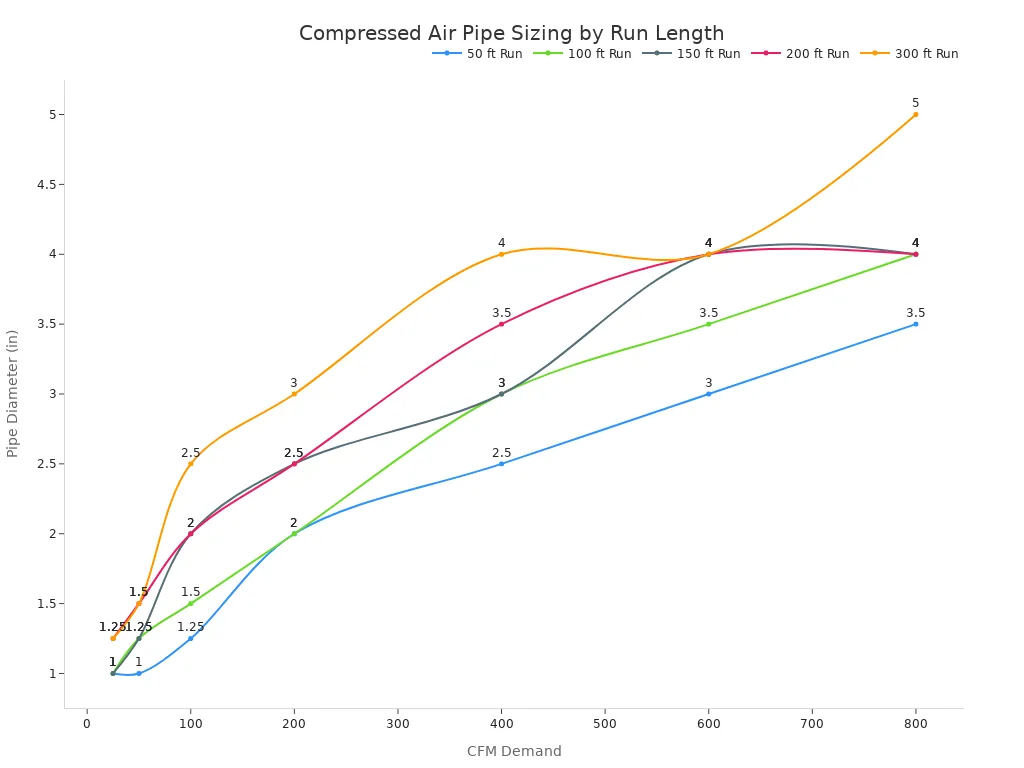
Pipe sizing directly affects moisture control and pressure drop. High velocity causes backpressure, erratic control signals, and turbulence. Velocity that is too low causes moisture to build up in pipes and controls. Size the mains to keep air velocity high enough to prevent moisture buildup and low enough to avoid backpressure and turbulence. Keep total pressure drop from compressor discharge to the most remote point of use within your calculated allowance.
Sizing Requirement
Design Guidance
Air velocity
Keep it high enough to prevent moisture buildup and low enough to avoid backpressure and turbulence.
Pressure drop
Stay within the calculated allowance from compressor discharge to the most remote point of use.
Fittings
Count their equivalent length in the pressure-drop calculation.
Always do a pressure drop calculation for your own layout before you finalize. Turn fittings into equivalent lengths of straight pipe before you calculate total pressure drop. Use the manufacturer’s equivalent-length values for elbows and tees. These details matter for accurate sizing.
Good support and alignment keep your pipes from stress and sagging. Follow the manufacturer's instructions closely when you install them. Space the supports correctly and keep the pipes aligned. Label every line and isolation valve clearly. Pressure test the whole system before startup to make sure it is leak-free.
Clean the inside of your 316L stainless steel piping before you add process air. This removes manufacturing residue and surface contaminants that could shed into your air stream.
Your system must be ready for CIP/SIP. It must handle strong chemical cleaning and steam sterilization without breaking down. Installation qualification (IQ) documents must show the compressor, stainless steel piping, and dryers match the approved P&ID drawings. The whole compressed air system — including dryer, receiver tanks, and distribution piping — must pass strict IQ/OQ/PQ validation. If you skip any part, your qualification is incomplete.
Testing, Documentation, and Revalidation
ISO 8573-1 defines purity classes for particles, water, and oil. Use the corresponding ISO 8573 test method for each contaminant. Validated sampling methods gather representative samples at set locations. An accredited lab analyzes these samples with calibrated instruments.
Contaminant
ISO Test Method
What It Measures
Particles
Applicable ISO 8573 test method
Number and size of particles
Water
Applicable ISO 8573 test method
Pressure dew point during operation
Oil
Applicable ISO 8573 test method
Total oil, including mist and vapor
Your documentation must include a Summary Report, Validation Protocol, and Test Reports. The Summary Report needs acceptance criteria, validation methods, result reviews, and deviation reports. Revalidation is needed when you make major equipment changes, change operational settings, or miss acceptance criteria. Do an ultrasonic leak survey on the distribution piping on a regular schedule. Tag each leak with location, estimated CFM loss, and priority. Record the pressure difference across each filter stage and replace filters at the manufacturer's suggested limits.
Make sure your ISO 8573-1 purity class fits your process.
Pick 316L stainless steel for areas that touch the product.
Check for smooth inside surfaces and orbital welds.
Make sure the system drains well and has no stagnant zones.
Ask for complete validation paperwork.
Picking the right material alone won't keep things clean. Design, installation, and upkeep all work together to decide your final air quality. Match every choice to GMP and ISO 8573-1 rules.
Check your system on a regular basis. Production needs shift over time. Revalidate when you change equipment or fail to meet acceptance criteria. This steady care keeps your product safe and your regulatory standing strong.
FAQ
Which compressed air purity class should a pharmaceutical plant target?
Most plants use ISO 8573-1 Class 1:2:1. That means Class 1 particles, Class 2 water at -40°C pressure dew point, and Class 1 oil at 0.01 mg/m³. Product-contact air may need Class 0. Check your process needs first.
Why choose 316L stainless steel over aluminum?
316L fights rust and has a smooth, crevice-free inside. Electropolished, crevice-free surfaces minimize particle trapping and biofilm growth. Aluminum fits industrial or utility circuits. Stainless steel stays the standard for pharmaceutical contact areas.
How do I keep moisture from contaminating my compressed air system?
Slope horizontal distribution lines toward drain points. Avoid stagnant pockets. Keep branch connections free of crevices and stagnant pockets. Drain condensate often. This design stops stagnant water zones where microbes live and multiply.
What validation tests should I expect before using new piping?
You need IQ, OQ, and PQ documentation. Use the applicable ISO 8573 test methods for particles, water, and oil. Include a Summary Report, Validation Protocol, and Test Reports. Revalidate after major equipment changes or failed acceptance criteria.
This website uses cookies to provide you with a safer and more personal experience. By accepting, you agree to the Cookie Policy and the use of cookies for advertising and analytics purposes.