Home > News > Blog > What Buyers Should Check When Choosing Hygienic Stainless Steel Compressed Air Pipe Fittings
# Blog
What Buyers Should Check When Choosing Hygienic Stainless Steel Compressed Air Pipe Fittings
2026-10-13
Share:
Check material grade, hygienic design, certifications, compatibility, and supplier assurance when choosing Hygienic Stainless Steel Compressed Air Pipe Fittings.
Compressed air touches products, ingredients, and packaging in food, drink, drug, and medical places. Clean air is a must for hygiene, and Hygienic Stainless Steel Compressed Air Pipe Fittings are a key control point. ISO 8573 sets air quality classes, and food and drug processes often need Class 1:2:1 air.
You should check five things before buying: material grade, hygienic design, certifications, compatibility, and supplier assurance. If you skip these checks, you risk contamination, leaks, rule-breaking, and costly downtime. This guide gives you practical rules to follow. For non-hygienic industrial air, aluminum systems are a good other choice.
Key Takeaways
Pick the right stainless steel grade: 304 works for most jobs, while 316L is best for strong chemicals or high-purity needs.
Check for hygienic design features such as smooth surfaces (≤0.8μm roughness) and connections without crevices to stop bacteria from growing.
The material grade you pick affects how well your compressed air system works. Stainless steel comes in different grades. Each grade has its own features for cleanliness, strength, and price. You need to match the grade to what your application needs.
304 vs. 316L Stainless Steel
Grade 304 stainless steel is good for general uses. It works for most compressed air systems in food and drink plants. This grade fights rust and handles normal cleaning. Many makers pick 304 for standard clean settings.
Grade 316L gives even better corrosion resistance. This grade has molybdenum in it. That element adds protection against chlorides and strong chemicals. Drug plants and medical places often ask for 316L. High-purity uses need this level of protection. The "L" means low carbon content. That feature stops carbide precipitation when welding. Welded joints stay strong and resist corrosion.
You should check your setting before you choose. Does your facility use harsh cleaners? Do you work with salty or acidic products? If yes, 316L is worth its higher price. For milder conditions, 304 gives solid performance at lower cost.
Corrosion Resistance and Cost Trade-Offs
Stainless steel has a big advantage. It will not corrode or break down on inside or outside surfaces. That property keeps your air supply safe from contamination. No rust bits get into your air stream. No surface breakdown makes hiding spots for bacteria.
This protection comes at a price. Stainless steel costs more upfront than aluminum options. You pay for the alloy content and the way it is made. However, you get decades of reliable service in clean applications.
Confirms that the products listed on the certificate were manufactured from material purchased in accordance with the stated specifications. Intended for reference purposes only.
Certified Material Test Report (CMTR)
A fee-based certificate of compliance in which a heat code enables material traceability back to the mill or point of origin.
Certificate of Origin
States the country of origin of the product. Intended for reference purposes only.
These documents protect you from fake or mislabeled materials. A CMTR traces your fittings back to the original mill. That traceability matters when audits happen.
For non-hygienic industrial air distribution, consider UPPER Aluminum Compressed Air Pipe. This system gives a cost-effective option. It comes in nominal diameters from DN20 to DN200. It works at pressure up to 16 bar. The modular design allows fast setup and easy growth. You give up the hygiene features of stainless steel. You gain lower material costs and simpler installation.
Your choice between 304 and 316L depends on your own hygiene needs. Match the grade to your setting. Ask for the right documents. Then check what you receive.
Hygienic design is more than just the material grade. The shape and finish of your fittings decide how clean your air stays. Bad design makes spots where bacteria and moisture build up. Good design keeps your system clean and working well.
Surface Finish and Cleanability
Smooth inside surfaces do two key jobs. First, they lower flow resistance and turbulence. That means less pressure drop across your system. Second, they limit spots where bacteria can stick and grow. Rough surfaces give microbes a place to hold on. Polished surfaces take that chance away.
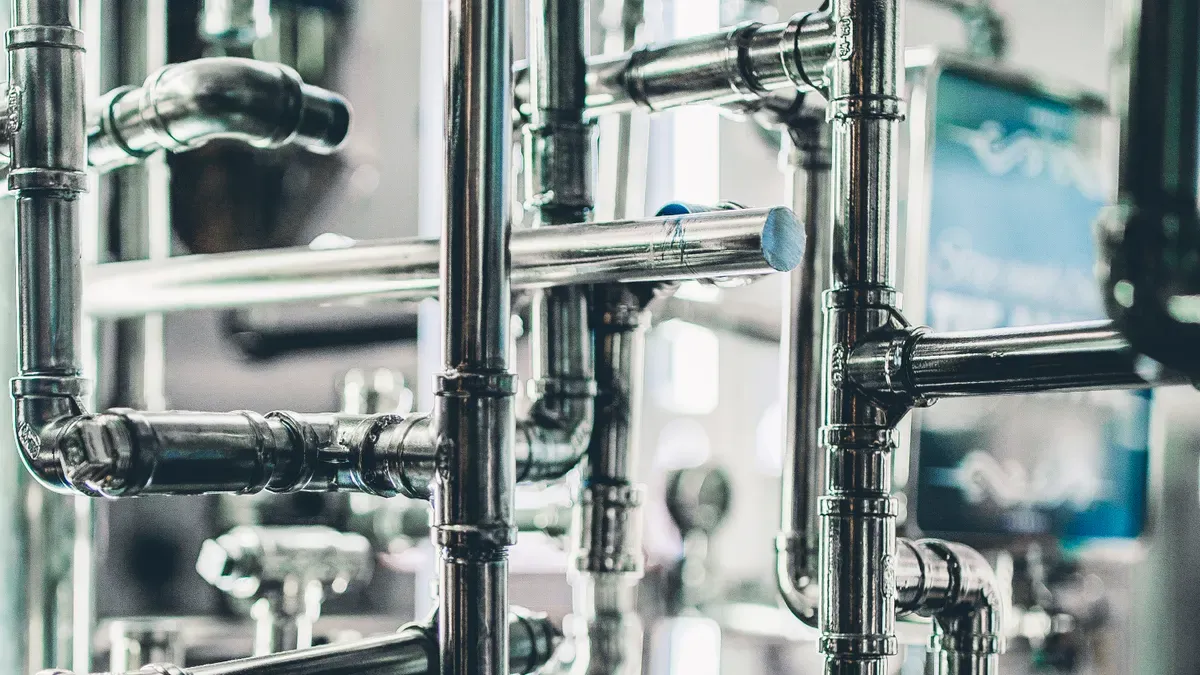
Ultra-smooth, corrosion-resistant sanitary fittings, often made of 316 stainless steel, prevent bacterial growth and product contamination.
You should look for fittings with a written surface finish. The industry standard for hygienic uses needs a surface roughness of ≤0.8μm on both inner and outer surfaces.
The inner and outer surfaces of the pipe fittings must have a surface roughness of ≤0.8μm. Mirror polishing greatly reduces the adhesion between water and the pipe wall, making it difficult for scale and biofilm to adhere and accumulate, thereby effectively preventing buildup from a material standpoint.
Ask your supplier for proof of this finish. A certificate or test report backs up the claim.
Crevice-Free and Drainable Construction
Crevices trap moisture and contaminants. Threaded joints and overlapping parts make tiny gaps. Those gaps turn into breeding grounds for bacteria. Hygienic Stainless Steel Compressed Air Pipe Fittings should have crevice-free designs. Every connection should seal flush with no hidden spaces.
Drainability matters too. Condensation forms in any compressed air system. Your fittings should let moisture flow out instead of pooling. A drainable design stops water from sitting inside the pipe. Standing water feeds microbial growth and rusts the metal over time.
Stainless steel often needs welded connections for high-purity uses. Welding makes a smooth, continuous surface with no gaps. However, welding needs skilled installation. A poor weld brings cracks and rough spots. Those flaws defeat the purpose of hygienic design. You should check that your installer has experience with sanitary welding. Ask for weld inspection reports before you accept the work.
Certifications for Hygienic Stainless Steel Compressed Air Pipe Fittings
Certifications show that your fittings follow the rules for your industry. You cannot tell if a product is good by how shiny it is or how much it costs. You must check the paperwork first. This step keeps your product, your workers, and your business safe.
ISO 8573 and ISO 4414 Compliance
ISO 8573 sets the quality classes for compressed air. ISO 4414 covers safety for pneumatic systems. Together, these standards give you a plan for clean, safe air.
ISO 8573-1 uses a three-number code for three groups of contaminants: particles, water, and oil. Classes go from 0 (the strictest) to 9 (the loosest). Class 0 is used for medical air and semiconductor work. Food, beverage, and drug plants usually need Class 1:2:1. General manufacturing and pneumatic tools can run at Class 3:4:3.
ISO 8573-1 sets classification limits, not test methods. The standard itself does not say which class to pick. That choice must come from product-contact risk, regulatory requirements, internal quality policies, and hazard analysis. Just saying "ISO 8573-1 compliant" is not enough without documented testing methods and data you can defend.
The water number matters most for hygiene. Class 2 requires a pressure dew point of −40 °C, which only a desiccant dryer can reach. General industrial Class 4 needs just +3 °C from a refrigerant dryer. This gap shows why hygienic air needs stricter drying.
Hygienic Application
Typical ISO 8573-1 Class
Food and beverage
Class 1:2:1
Pharmaceutical manufacturing
Class 1:1:1
Medical devices
Class 1:2:1 or stricter
Medical air
Class 0
FDA, EU 1935/2004, and OSHA Requirements
FDA rules treat compressed air as a critical control point. Under 21 CFR 117.40(g), any gas that touches food or food-contact surfaces must not add unlawful indirect additives to the product. FDA does not publish one required test panel or purity class for every plant. Your program depends on your product, your process, and your risk. You must document filter maintenance, oil carryover testing, moisture monitoring, and microbial controls, with timestamps and signatures.
EU 1935/2004 sets similar duties for European markets. Materials must not release harmful substances into food. They must not change the food's makeup, taste, or smell. The regulation requires compliance documents and traceability. Overall migration must stay at or below 10 mg/dm², or 60 mg/kg for items meant for infants. A Declaration of Compliance backs every shipment.
OSHA governs worker safety for compressed air piping. Under 1910.242(b), compressed air used for cleaning must not go over 30 psi at the outlet under static conditions. Chip guards and personal protective equipment are also required.
High- and low-pressure air supply lines need check valves
1926.803(h)(8)
Low-pressure air must be regulated automatically
1926.803(h)(9)
Air intakes must sit where fumes and gases are minimized
1926.803(h)(10)
Pressure gauges must be installed at key stations
Check certification documents before you compare price or looks. A cheap fitting without papers costs far more when an audit fails. Ask for test reports, declarations, and traceability records for every Hygienic Stainless Steel Compressed Air Pipe Fittings order.
Compatibility and Sizing
You need to match your fittings to the conditions you really work in. Begin with where and how they will be installed. Will the pipes be outside or in a washdown area? Do nearby processes make heat or shaking? Then, write down your flow, temperature, and pressure needs, both low and high. A fitting made for 10 bar will break in a 16 bar line. A seal that works at room temperature may split in a hot washdown. Write these numbers down before you buy.
Pressure Ratings and Temperature Limits
Every Hygienic Stainless Steel Compressed Air Pipe Fittings order needs a pressure rating higher than your system's top level. Check the rating at your hottest working temperature, not at room temperature. Most materials get weaker as heat goes up. A fitting rated for high pressure at 20°C may hold much less at 80°C. Ask your supplier for a pressure-temperature derating curve. If they cannot give you one, do not buy from them.
Temperature limits also affect your seals and gaskets. Standard elastomers have a top limit far below what steam cleaning reaches. You need seal materials rated for your cleaning cycle. Tell your supplier both your process temperature and your cleaning temperature. The higher number decides your choice.
Connection Types and System Integration
Connection style decides how clean your system stays and how fast you can build it. Each type fits different hygiene levels and budgets.
Connection Type
Best For
Hygiene Level
Threaded
General industrial air
Lower; gaps trap debris
Welded
High-purity, pharmaceutical
Highest; smooth, crevice-free
Clamped
Food and beverage, washdown
High; easy to open and inspect
Threaded joints leave tiny gaps. Those gaps collect moisture and bacteria. Welded joints give you a smooth surface with no hiding spots. Clamped connections let you open the line for cleaning and inspection.
Stainless steel often needs welded connections for high-purity work. That takes skilled labor and slows installation. Modular aluminum systems like UPPER offer fast setup and easy growth. UPPER pipes come in DN20 to DN200 and handle up to 16 bar. You trade hygiene features for speed and lower cost. Match the connection type to your hygiene class, your budget, and your maintenance plan.
Supplier Assurance and Quality Control
A good supplier supports every Hygienic Stainless Steel Compressed Air Pipe Fittings order with papers and help. You need proof that your fittings match the grade you ordered. You also need a partner who helps when problems come up.
Traceability and Material Test Reports
Material test reports and traceability papers confirm the grade and origin of your fittings. These papers link your parts back to the original mill heat. A Certified Material Test Report (CMTR) gives you that chain of custody. Without it, you cannot prove your fittings meet FDA or EU 1935/2004 rules during an audit.
Ask your supplier for a CMTR with every order. Check that the heat code on the report matches the code on your fittings. This step catches mislabeled or fake materials before they enter your system. Keep these records on file for at least the life of your piping system.
Testing, Warranty, and Support
Suppliers should pressure-test every fitting before shipment. Ask for test data that shows each batch held its rated pressure without leaks. Good suppliers also offer strong warranty terms and technical help.
Schedule regular checks of your fittings to look for leaks, corrosion, or wear. Ultrasonic leak detection surveys find hidden air loss. Check for dead legs and low-point traps where moisture collects. Verify point-of-use pressure and look into any drop greater than 0.3 bar. Test your air quality at least once a year for food-contact points. Many certification standards require quarterly or semi-annual testing. Increase testing after any system change or out-of-spec result. Keep your system clean and document every inspection in your maintenance system.
You now know the five checks that matter most: material grade, hygienic design, certifications, compatibility, and supplier assurance. Each check keeps your system strong, your product safe, and your rules followed. Before you buy Hygienic Stainless Steel Compressed Air Pipe Fittings, ask for documents, samples, and test reports. These steps prove the grade, finish, and performance you expect.
A careful purchase pays you back for years. You avoid contamination, leaks, failed audits, and downtime. Your long-term costs go down and your risks get smaller. The right choice depends on your application hygiene needs. Match the fitting to your process, and your compressed air system will serve you well.
FAQ
Which grade should you pick, 304 or 316L?
It depends on where you use it. Grade 304 works well for general food and beverage use. Grade 316L handles harsh chemicals, chlorides, and high-purity drug or medical applications. Check your cleaning agents and products first. Then match the grade to your hygiene needs.
What surface finish do hygienic fittings need?
You need a surface roughness of ≤0.8μm on both inner and outer surfaces. This smooth finish lowers pressure drop and stops bacteria from sticking. Ask your supplier for a certificate or test report that proves this finish before you buy.
Which certifications should you verify?
Check for ISO 8573 and ISO 4414 compliance. Food-contact and drug applications also need FDA and EU 1935/2004 documentation. OSHA rules apply to compressed air piping safety. Always verify certification papers before you compare price or appearance.
Which connection type suits your system?
Threaded joints fit general industrial air but trap debris. Welded connections give the highest hygiene for pharmaceutical use. Clamped connections work well for food and beverage washdown areas. Match the connection type to your hygiene class, budget, and maintenance plan.
What documents should your supplier provide?
Ask for a Certified Material Test Report (CMTR) with every order. This report traces your fittings back to the original mill heat. Suppliers should also provide pressure test data, warranty terms, and technical support. Keep these records for the life of your piping system.
This website uses cookies to provide you with a safer and more personal experience. By accepting, you agree to the Cookie Policy and the use of cookies for advertising and analytics purposes.