Home > News > Blog > Which Compressed Air Piping Manufacturer Offers Global Export Service
# Blog
Which Compressed Air Piping Manufacturer Offers Global Export Service
2026-09-14
Share:
Global compressed air piping manufacturers support overseas projects with certified products, reliable logistics, flexible solutions, and responsive technical service for buyers.
Top compressed air piping manufacturers offer global export service. Upipe, Gardner Denver, Kaeser, and Transair lead the market. Their worldwide reach shows they can deliver internationally with confidence.
The global compressed air piping market reached US$ 3,489.79 million in 2026. These suppliers do well because of proven export experience, international certifications, and strong logistics networks. Upipe exports aluminum systems with a ten-year guarantee and support teams. Gardner Denver serves over 150 countries. Kaeser supplies complete air systems. Transair uses Parker Hannifin's 13,000 global locations.
Engineers and procurement managers trust these compressed air piping manufacturers for their credentials and reliability across borders.
Key Takeaways
Leading makers such as Upipe, Gardner Denver, Kaeser, and Transair provide worldwide shipping service.
Upipe is a compressed air piping manufacturer that offers a full aluminum pipe system. The product line includes aluminum pipes, valves, elbows, metal flexible hoses, pipe-to-pipe connectors, fixed clamps, instruments and meters, tees, install accessories, thread connectors, flanges, end caps, quick drops, and tools. This range works for compressed air, vacuum, and inert gas uses. The modular design lets you set up flexible layouts and install things quickly. Corrosion resistance keeps the system stable over time in industrial settings.
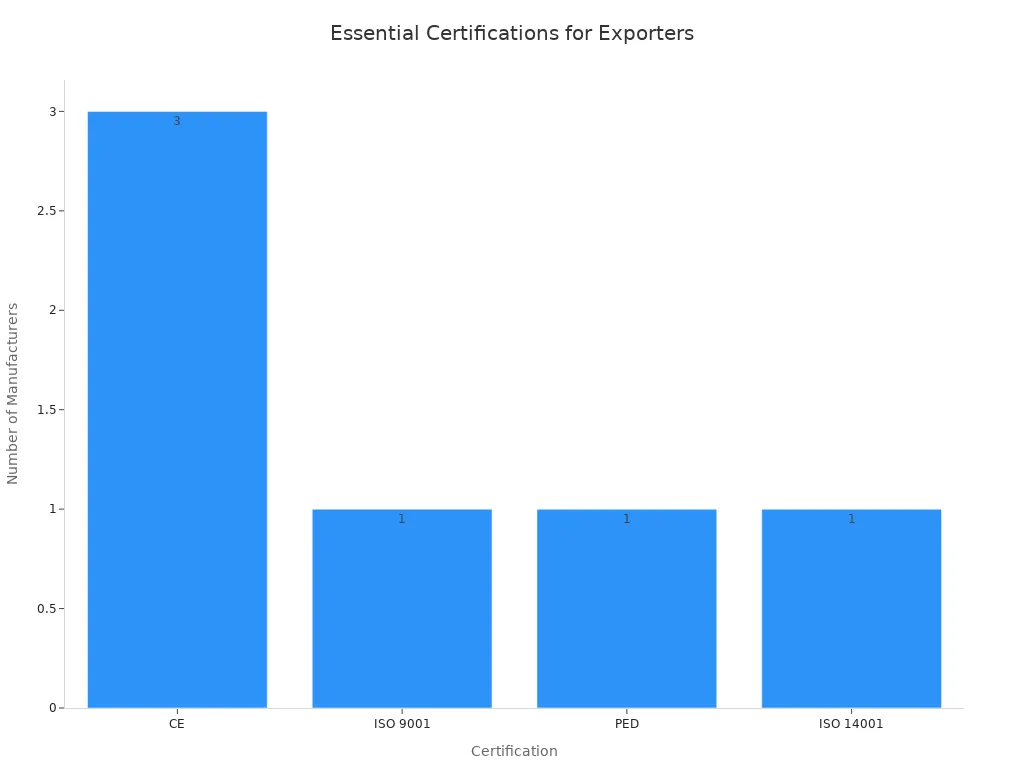
Upipe has ISO 9001 certification for quality management systems and ISO 14001 certification for green production. The company also holds CE certification, national building materials inspection certification, special equipment-related certifications, and salt spray testing certification. Many invention and utility model patents support the product line. These credentials show a strong commitment to quality and safety for international buyers.
Gardner Denver and Kaeser
Gardner Denver brings many years of export experience. The company ships to over 150 countries, which proves it can handle complex international logistics. This wide reach makes Gardner Denver a dependable choice for procurement managers who want a compressed air piping manufacturer with proven global delivery.
Kaeser Compressors provides complete compressed air systems for industrial uses. The company offers products, services, and full systems that supply production and work processes with quality compressed air. The system range includes portable and stationary compressors such as blowers, rotary screw compressors, and reciprocating compressors. Kaeser also offers controllers and solutions for air distribution, storage, and treatment, plus condensate technology. SmartPipe aluminum piping from Kaeser resists corrosion, is easy to install, and is built for better airflow. The systems are made in Germany using high-precision machinery. Kaeser serves industries like automotive, plastics manufacturing, pharmaceutical plants, and dry-cleaning facilities. The Sigma Air Utility option gives compressed air as a service for customers who want to skip investment costs.
Rapidair Australia is an example of an importer and distributor for regional reach. This kind of local partner helps manufacturers grow into specific markets. Buyers in Australia and nearby regions can get products through these established channels.
These manufacturers show different strengths. Upipe offers a broad aluminum system with strong certifications. Gardner Denver provides extensive export experience. Kaeser delivers complete engineered systems with German precision. Each option fits different project requirements and regional needs.
Three things separate reliable exporters from others. Certifications, shipping, and after-sales support decide international success. Every buyer must check these areas before choosing a compressed air piping manufacturer.
International Certifications and Standards
Certifications show quality and safety rules are met. ISO 9001 is for quality management. ISO 45001 is for health and safety. ISO 14001 is for environmental management. PNEUROP stands for European trade groups for compressed air equipment.
ISO 8573-1 sets compressed air purity classes. It has limits for particles, water, and oil. The piping network must keep these levels from the compressor to the point of use. Bad piping puts contaminants back after filtration.
After-sales support keeps systems working. Top exporters offer 24/7 emergency service, warranty, and local support. One customer said, "Customer service has been great. Any questions about orders get fast replies."
Service Category
Examples
Emergency Support
24-hour help for breakdowns
Maintenance
Preventive maintenance plans
Technical Support
Help with parts and tools
Installation
Full system installation
Repair Services
Fast repair turnaround
Customer Service
Quick problem solving
Training
Training and demos for staff
The metal compressed air pipe market hit $3.8 billion in 2025. Forecasts show growth to $6.4 billion by 2034, a 5.9% yearly rate. As the market grows, reliable after-sales support becomes more important.
Evaluating a Compressed Air Piping Manufacturer's Credentials
Portfolios, Testimonials, and Language Support
A strong project portfolio shows real success in different parts of the world. Ask for case studies from factories, food plants, and hospitals. These examples prove the supplier can work in many kinds of industrial settings. Client testimonials add more trust. Good feedback about correct orders and fast replies shows the service is reliable. A compressed air piping manufacturer with many different installations shows it can adapt and has technical skill.
Language support matters for smooth international projects. Upipe offers help in many languages through different channels. The table below shows the choices you can use.
Support Channel
Languages Available
Technical Team
English, French, Spanish
Sales Team
English, French, Spanish
Telephone Services
English, French, Spanish
Gardner Denver gives export support to more than 150 countries. Their team helps with design, setup, and service. They know international rules and shipping needs. However, they do not list specific language options. Buyers should check communication abilities before they commit.
Warranty Policies and Documentation
Warranty terms protect your investment after delivery. Standard coverage for exported piping systems usually includes a component warranty against manufacturing defects. This covers all piping components installed by the engineering team. An installation warranty often comes with the component warranty. Export-specific warranty terms may not always show up in the first documents. Buyers should ask for written confirmation of coverage for international orders.
Export documentation makes customs clearance go smoothly. Certificates of origin prove where the product was made. Compliance sheets confirm adherence to standards like ISO 8573-1 or CE marking. Customs paperwork must match the commercial invoice exactly. Check that model numbers, quantities, and country of origin match across all documents. Missing or wrong paperwork causes delays and extra costs at the border. A reliable supplier gives complete documentation before shipment.
Tips for Working With Export-Experienced Suppliers
Contract Essentials
Delivery terms decide who carries risk at each stage. The International Chamber of Commerce suggests FCA, CPT, or CIP for pipe shipments in containers. These terms fit containers better than FOB, CFR, or CIF. With FOB and CIF, risk passes only when goods are on the vessel. Containers reach the terminal days before loading, which leaves a risk gap. CIP also gives broader insurance coverage under Institute Cargo Clauses A. CIF only covers Clauses C. For compressed air piping in containers, FCA, CPT, and CIP are the safest picks.
Warranty clauses need clear wording. The table below shows common coverage for exported systems.
Warranty Aspect
Coverage Details
Compressor warranty duration
10 years from installation or 120 months from delivery, whichever comes first
Dryers and accessories
1-year limited warranty
Labor coverage
Not covered under warranty
Conditions to maintain warranty
Follow the exact maintenance schedule; use genuine manufacturer parts; do not modify parts or schedule
Indoor and clean environment; keep environmental factors to a minimum
Buyers should also confirm these points in writing:
Seller warrants products are free from defects in workmanship and material.
Spare parts carry a 90-day warranty from installation or 12 months from factory shipment, whichever comes first.
Repaired or replaced parts carry 90 days or the rest of the product warranty, whichever is longer.
Consumables and normal wear and tear are not included.
Buyer must tell the seller in writing within the warranty period.
Communication Best Practices
Knowing time zones prevents delays. Schedule calls during business hours that overlap. Confirm deadlines in writing after each talk. Clear technical specifications cut down on errors. Share pressure ratings, pipe diameters, and connection types before production starts. Regular progress updates keep both sides on the same page. Ask for photos or inspection reports at key steps.
Request quotes and samples before you commit. A sample confirms material quality and fitting accuracy. Compare quotes from at least two suppliers. Check that each quote lists Incoterms, payment schedule, and warranty terms. A reliable compressed air piping manufacturer answers these questions without hesitation.
Upipe, Gardner Denver, Kaeser, and Transair are top choices for global export. Upipe provides a wide aluminum system with solid certifications. Gardner Denver delivers to more than 150 countries. Kaeser offers complete engineered systems made with German precision. Transair relies on Parker Hannifin's worldwide network.
Certifications, logistics, after-sales support, and clear contracts are the most important things. Buyers should look for ISO 9001, ISO 8573-1, and CE marking. Make sure shipping terms and warranty coverage are written down. Use the evaluation tips above to compare portfolios, language support, and paperwork.
Picking a dependable compressed air piping manufacturer keeps your international project safe. Reach out to suppliers directly or ask for a quote today.
FAQ
What certifications should a global compressed air piping manufacturer hold?
ISO 9001 shows quality management is in place. ISO 14001 covers environmental standards. CE marking meets EU safety rules. ISO 8573-1 checks compressed air purity. These credentials prove the company follows international requirements.
How do I verify a manufacturer's export experience?
Look at project portfolios and client testimonials from different regions. Ask how many countries they serve and about their shipping history. Check if they have multilingual support teams. A manufacturer with documented global deliveries gives you stronger reliability.
Which Incoterms work best for international pipe shipments?
FCA, CPT, or CIP fit container shipments best. These terms pass risk at the container terminal, not at the vessel. CIP gives broader insurance coverage under Institute Cargo Clauses A.
What warranty coverage should I expect for exported piping systems?
Expect a 10-year warranty on compressors and a 1-year warranty on accessories. Coverage includes manufacturing defects but leaves out labor and consumables. Follow the required maintenance schedules to keep warranty terms active.
How do I avoid customs delays when importing compressed air piping?
Give accurate commercial invoices with correct HS codes and country of origin. Confirm compliance documents like certificates of origin before shipment. Work with a customs broker in the destination country.
This website uses cookies to provide you with a safer and more personal experience. By accepting, you agree to the Cookie Policy and the use of cookies for advertising and analytics purposes.