Home > News > Blog > Which Compressed Air Piping Suppliers Provide Installation and After-Sales Maintenance
# Blog
Which Compressed Air Piping Suppliers Provide Installation and After-Sales Maintenance
2026-10-16
Share:
Transair, Prevost, AIRnet, Infinity, UPPER, DIRECTAIR, CMC, Air Services, and Fluid-Aire Dynamics offer installation and after-sales maintenance for compressed air piping.
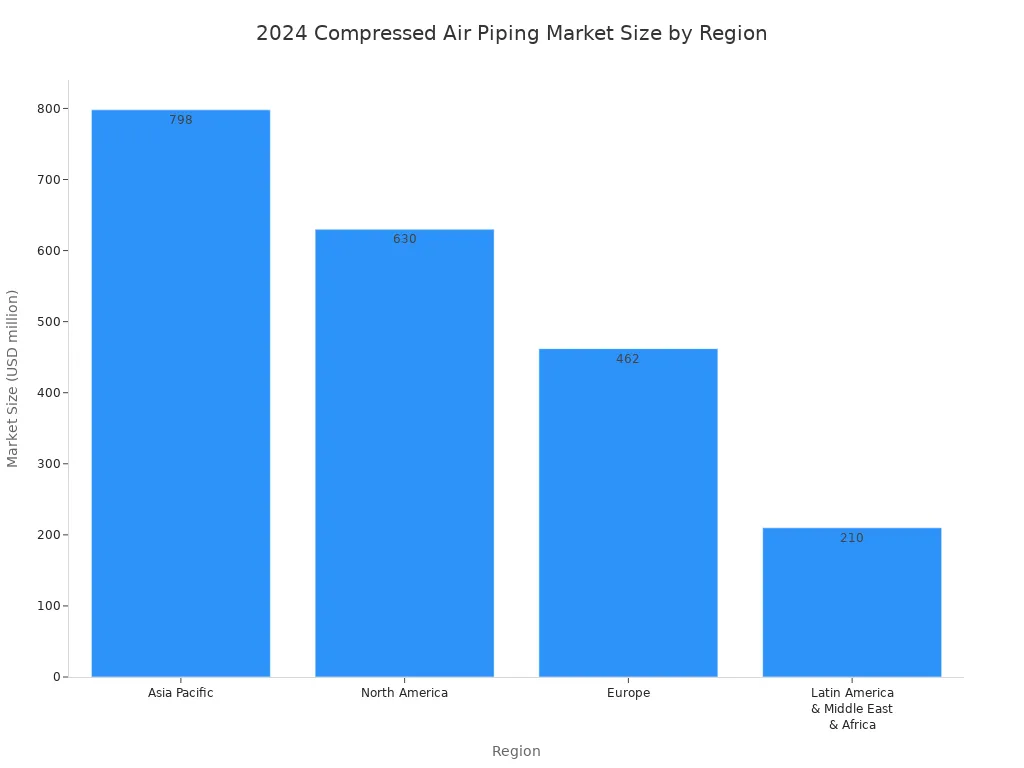
Transair, Prevost, AIRnet, Infinity Pipe Systems, UPPER, DIRECTAIR, CMC, Air Services Company, and Fluid-Aire Dynamics all offer installation and after-sales maintenance for compressed air piping systems. These compressed air piping suppliers serve a growing market, and the global compressed air pipe market reached USD 7.2 billion in 2024 with a projected CAGR of 4.4%.
About 70% of all manufacturers have a compressed air system, so this article breaks down each supplier's installation and maintenance services. A comparison table and selection tips follow to help readers choose the best partner for their facility, since each supplier typically offers different warranty terms and service coverage.
Key Takeaways
Many suppliers, such as Transair and CMC, provide installation and maintenance for compressed air piping systems.
Pick a supplier based on local service coverage, warranty length, and total cost of ownership.
Aluminum piping systems cost less and go in faster than old materials like iron or copper.
Before you buy, ask suppliers about their installation skills, after-sales help, and references.
Keeping up with regular maintenance stops energy waste and expensive leaks in your compressed air system.
Top Compressed Air Piping Suppliers
Many compressed air piping suppliers now offer more than just pipes and fittings. They also provide full installation services and ongoing after-sales maintenance. This section introduces the leading suppliers in two different groups. Each group brings different strengths to a facility's air system project.
Manufacturer-Based Suppliers
Piping manufacturers design and make their own compressed air piping systems. They often sell through certified distributors and installation partners. This group includes Transair, Prevost, AIRnet, Infinity Pipe Systems, and UPPER.
These manufacturers focus on the piping product itself. They build modular aluminum systems that factories can expand or change over time. Their installation networks handle the actual build. Their after-sales teams help with leak detection, system upgrades, and replacement parts.
ISO 9001 — a quality-management certificate at the factory level, which is what matters most for most international buyers.
Destination-market electrical or pressure-vessel evidence — required by the buyer's region.
ISO 8573-1 air-quality class verification — relevant when the process is controlled by ISO 8573-1 air-quality classes; buyers should ask how the delivered system is verified to meet the required class, not just at the compressor outlet.
Export documentation — including commercial invoice, packing list, certificates of origin, HS-code support, test reports, and translated manuals.
CE marking — mentioned as a typical certification relevant to industrial air compressor manufacturers.
Buyers should ask each manufacturer which certifications apply to their specific order. The answer often depends on the destination market and the end-use application.
Full-Service Compressed Air Companies
Full-service compressed air companies take a different approach. They do not make piping themselves. Instead, they design, install, and maintain complete compressed air systems using products from many brands. This group includes DIRECTAIR, CMC, Air Services Company, and Fluid-Aire Dynamics.
These companies act as single-source partners. A factory can hire one firm to assess air demand, design the layout, install the piping, and handle all ongoing maintenance. This model suits facilities that lack in-house engineering staff or prefer to outsource system management.
DIRECTAIR provides design, installation, and optimization services. CMC offers service, parts, repairs, maintenance, leak detection, audits, installation support, and 24/7 emergency service. Air Services Company delivers piping solutions from Gardner Denver, Transair, and Infinity. Fluid-Aire Dynamics helps customers select, install, and maintain their compressed air systems.
The full-service model cuts down coordination work for the buyer. One contact manages the entire project from start to finish. However, the buyer should confirm which piping brands each company carries and whether local service teams cover their region.
Both supplier groups can deliver installation and after-sales maintenance. The right choice depends on a facility's internal capabilities, budget, and long-term service needs. The following sections examine each supplier's specific offerings in detail.
Transair and Prevost: Installation and Maintenance
Transair is a Parker Hannifin brand that makes modular aluminum piping systems. The company uses certified installers to put the pipe network together without welding or threading. This method saves installation time and lowers the chance of bad connections. Prevost also offers installation services for its compressed air piping systems. Both brands train their installation partners to follow strict layout and support rules.
Good installation matters more than many buyers think. Bad piping design makes the system use more power just to beat friction and leaks. A poor layout causes air starvation at the end of long, undersized runs. This leads to production stops or quality problems. Common installation mistakes and their measurable results include:
Undersized pipes raise velocity, increase pressure drops, and cause uneven tool performance.
Each 90° elbow adds pressure loss equal to about 3–5 feet of straight pipe.
Ignoring moisture and drainage puts water at tool outlets and rusts fittings.
Skipping proper support lets pipes sag, vibrations loosen joints, and leaks form at connections.
These problems raise energy costs. Every 2 PSI increase in system pressure to make up for pressure drop raises energy costs by about 1%. Compressed air can make up 10–30% of a facility's total electricity bill.
After-Sales Maintenance
Transair offers after-sales support that includes leak detection and system expansion. Certified technicians can inspect the network, find leaks, and add new drops as production needs change. Prevost provides maintenance programs for its compressed air piping systems. These programs help facilities keep their air networks running well over time.
Ongoing maintenance protects the investment. A lack of maintenance and inspections lets leaks go undetected. A single 1/8" leak can cost $1,200 per year in losses. Dust and oil buildup also lower air quality, and rust harms the internal pipe surface. Both Transair and Prevost handle these issues through scheduled service visits and replacement parts. Buyers should confirm that local service teams cover their region before they commit to either brand.
AIRnet, Infinity, and UPPER: Installation and Maintenance
AIRnet is an Atlas Copco brand. It provides a full compressed air piping system, from design to installation. The company manages the whole project and offers after-sales service once the system is running. AIRnet uses a push-and-press press-fit joining method. This method removes the need for welding and threading steps. One installer can put the network together, and the process goes up to 85% faster than regular piping systems. No heavy machines are needed at the site.
Installation Aspect
AIRnet System
Traditional Compressed Air Piping
Installation speed
Up to 85% faster
Slower due to welding/threading
Number of installers
Single installer
Typically multiple workers
Joining method
Push & press press-fit
Welded and threaded connections
Equipment needed
No heavy machinery
Heavy tooling often needed
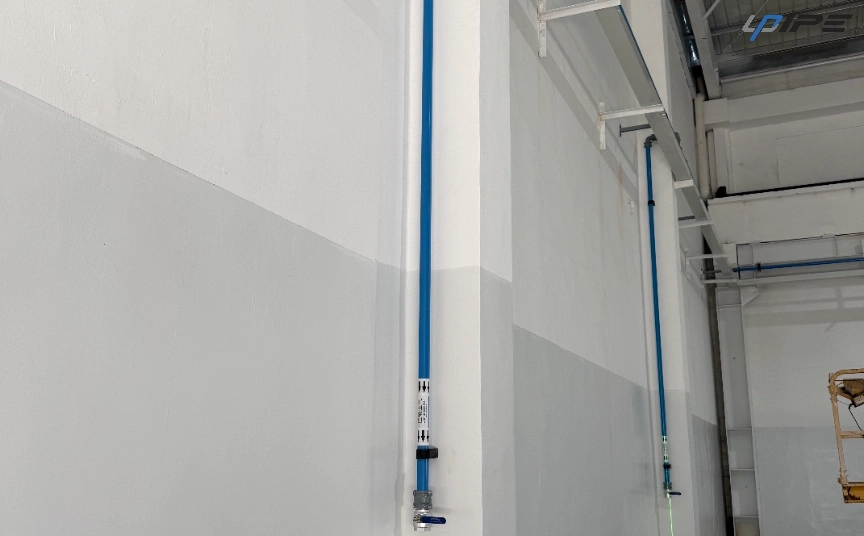
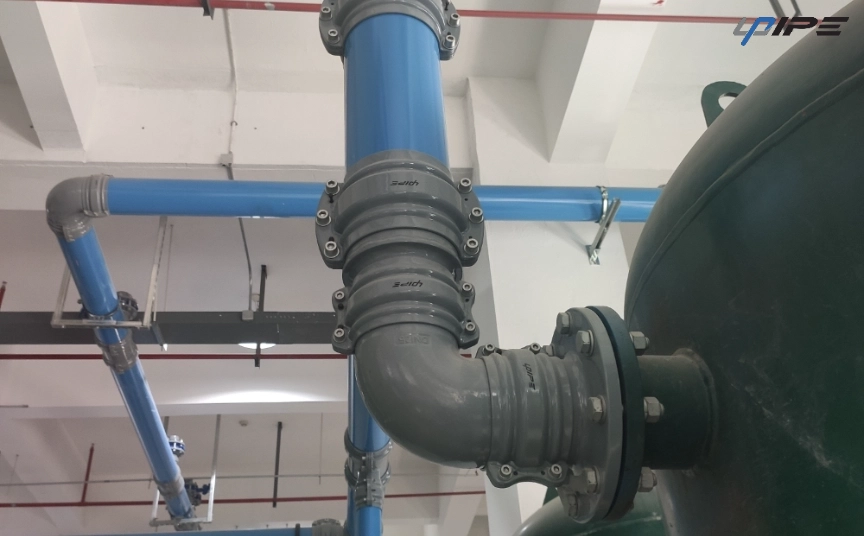
Infinity Pipe Systems provides installation and maintenance for its aluminum piping range. UPPER Aluminum Compressed Air Pipe offers installation guidance through its distributor network. The UPPER system uses extruded aluminum alloy for compressed air, vacuum, and inert gas. It comes in sizes from DN20 to DN200, with a 16 bar working pressure and a 5.8 m standard length. Blue, yellow, and grey colors help tell different lines apart. Modular fittings like tees, elbows, and flanges allow fast installation, quick changes, and future growth without welding or threading.
Ongoing maintenance keeps any compressed air network working well. Key performance indicators include specific power, leakage rate, and pressure loss. Specific power measures kW per 100 cfm and shows overall energy efficiency. Leakage rate and pressure loss show hidden waste. Dew point monitoring tracks air dryer performance. Temperature checks support dew point and dryer data. Carbon footprint tracking supports goals to reduce emissions.
AIRnet provides after-sales service as part of its complete system package. Infinity Pipe Systems takes care of its aluminum piping range. UPPER supports after-sales maintenance through its certified distributor network. Buyers should make sure local distributors cover their area and carry spare fittings before they commit.
Comparing Compressed Air Piping Suppliers
A side-by-side comparison helps buyers see the real differences between compressed air piping suppliers. The table below sums up piping material, installation service, after-sales maintenance, warranty, and service coverage for each major supplier.
Full-service companies like DIRECTAIR, CMC, Air Services Company, and Fluid-Aire Dynamics give more support than piping makers alone. CMC stands out with 24/7 emergency service, leak detection, audits, and installation support. DIRECTAIR focuses on design, installation, and optimization. Air Services Company delivers piping solutions from Gardner Denver, Transair, and Infinity. Fluid-Aire Dynamics helps customers pick, install, and care for their systems.
Warranty and Service Coverage
Warranty terms differ a lot across the market. Infinity Piping offers a 10-year leak-free warranty on its all-aluminum construction, including fittings. Fastpipe gives only a 12-month warranty, possibly because it uses nylon fittings to join rigid aluminum pipe sections. Makers of competing products using aluminum fittings offer warranties longer than 12 months.
Some compressor brands offer structured warranty programs that extend coverage. The Royal Blue Warranty gives 10 years for airends and 5 years each for variable speed drives, drive motors, air/fluid receivers, drive coupling, and coolers. The True Blue Warranty offers 1 year of basic compressor coverage plus 5 years each for airends, coolers, air fluid receivers, and drive motors. The No Bull Extended Warranty doubles package warranty to 2 years and pump warranty to 3 years, including basic regular maintenance coverage for 3 years. The Blue Shield Extended Warranty adds 3 or 5 extra years to the factory warranty for rotary screw compressors at least 5 years old and rated 150 PSIG and lower.
Local service coverage matters as much as warranty length. A 10-year warranty means little if no technician can reach the facility in a reasonable time. Buyers should confirm that local distributors stock spare fittings and employ certified installers. CMC offers 24/7 emergency service, which suits facilities that cannot handle downtime. Other suppliers rely on regional distributor networks, so coverage depends on where the buyer is located.
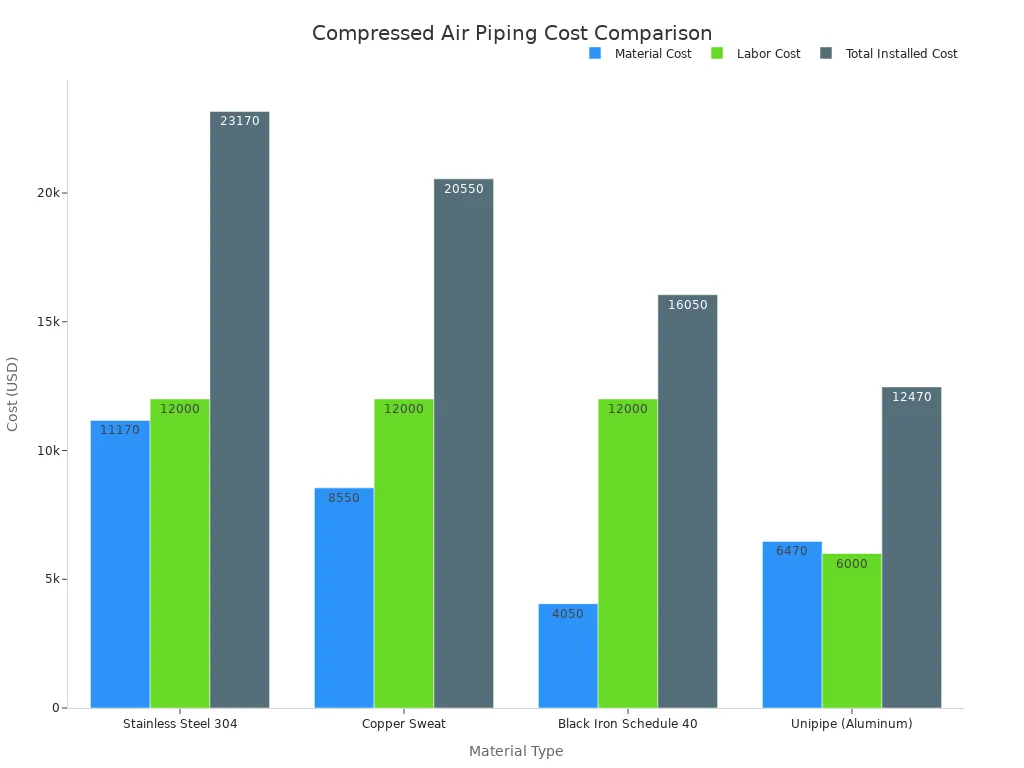
Aluminum piping systems cut total installed cost compared to traditional materials. Aluminum's total installed cost is about 22% lower than black iron, 39% lower than copper, and 46% lower than stainless steel. Aluminum piping can be installed in about half the time of black iron, steel, or copper. No threading, grooving, welding, or soldering is needed.
Buyers should weigh warranty length against local service coverage. A shorter warranty with strong local support may serve a facility better than a long warranty with distant technicians.
How to Choose a Supplier
Key Factors to Consider
Buyers should think about several things before they pick a supplier. The piping material matters because aluminum systems fight rust and go in faster than older materials. Installation ability shows whether the supplier handles site visits, planning, and setup. After-sales maintenance scope shows what help continues after the job ends. Warranty length protects the money you spend over time. Local service coverage makes sure technicians can get to your facility fast. Total cost of ownership ties all these things together.
Total cost of ownership goes far beyond the price you pay up front. Electrical energy makes up about 80% of compressor-related costs. Every one bar increase in working pressure needs around 8% more power. A high-efficiency compressor that costs more at first often gives lower energy bills and fewer repairs over its life. Skipping maintenance can raise operating costs by 15–25% each year. Buyers who compare compressed air piping suppliers on purchase price alone may miss these long-term costs.
"Electrical energy, which accounts for 80% of compressor-related expenses, is the dominating factor in the overall cost of compressed air systems."
Questions to Ask Before You Buy
A clear set of questions helps buyers tell strong suppliers from weak ones. The answers show technical depth, service commitment, and honesty. Buyers should ask for references and site visits to check the claims.
Can the supplier give engineering know-how, like airflow calculations, pipe sizing advice, pressure drop analysis, and network optimization support?
Does the supplier offer installation expertise such as site surveys, installation planning, professional setup, and system testing?
Can the supplier share past project case studies and references from other industrial clients?
Will the supplier let you visit a site to watch installations in action?
Does the supplier give detailed proposals that clearly explain their approach to design, materials, and after-sales service?
What is the quality of the materials used — strength, durability, rust resistance, pressure ratings, and connection technology?
Does the supplier's system allow future growth without big disruptions?
Warning signs include not wanting to give references, vague proposals, poor documentation, and avoiding site visits. Buyers should see these signals as reasons to look somewhere else.
Transair, Prevost, AIRnet, Infinity Pipe Systems, UPPER, DIRECTAIR, CMC, Air Services Company, and Fluid-Aire Dynamics all offer installation and after-sales maintenance. Each compressed air piping supplier takes care of both building the system and keeping a facility's air network running.
Buyers should think about service coverage, warranty length, and local support before they choose. A long warranty does not help much if no technician can get to the site. Having local parts and quick emergency response often matters more.
Ask two or three suppliers for quotes. Compare their installation and maintenance packages side by side. That simple step shows the best fit for the facility.
FAQ
Do all compressed air piping suppliers offer installation services?
No. Manufacturer-based suppliers like Transair, Prevost, AIRnet, Infinity, and UPPER work through certified distributors and installation partners. Full-service companies like DIRECTAIR, CMC, Air Services Company, and Fluid-Aire Dynamics handle installation directly. Buyers should check if their chosen supplier does on-site installation or depends on a local partner network.
What does after-sales maintenance typically include?
After-sales maintenance covers leak detection, system expansion, replacement parts, and scheduled service visits. CMC offers 24/7 emergency service, leak detection, and audits. Transair provides leak detection and system expansion support. UPPER supports maintenance through certified distributors. Buyers should make sure local teams stock spare fittings and can reach their facility quickly.
How long do warranties last on compressed air piping systems?
Warranty terms vary widely. Infinity Pipe Systems offers a 10-year leak-free warranty on its all-aluminum construction. Fastpipe provides only a 12-month warranty. Some compressor brands offer extended programs covering airends for 10 years. Buyers should weigh warranty length against local service coverage, since a long warranty means little without nearby technicians.
Why does installation quality affect long-term costs?
Poor installation raises energy costs. Undersized pipes increase pressure drops. Each 90° elbow adds pressure loss equal to about 3–5 feet of straight pipe. Every 2 PSI increase in system pressure to make up for pressure drop raises energy costs by about 1%. Compressed air can make up 10–30% of a facility's total electricity bill.
How much can aluminum piping systems save compared to traditional materials?
Aluminum piping cuts total installed cost a lot. Aluminum's total installed cost is about 22% lower than black iron, 39% lower than copper, and 46% lower than stainless steel. Aluminum piping also installs in about half the time of black iron, steel, or copper. No threading, grooving, welding, or soldering is needed.
This website uses cookies to provide you with a safer and more personal experience. By accepting, you agree to the Cookie Policy and the use of cookies for advertising and analytics purposes.