Home > News > Blog > How to Choose Compressed Air Pipeline Contractor for Industrial Projects
# Blog
How to Choose Compressed Air Pipeline Contractor for Industrial Projects
2026-11-02
Share:
Choose a compressed air pipeline contractor by checking references, demanding a written design package, and comparing materials for efficiency.
Your compressed air piping system will serve the facility for years. That makes choosing a compressed air pipeline contractor a very important decision. A poor choice brings real problems: pressure drops at critical points, leaks that waste energy, compliance failures at inspection, and costly rework. You need a practical evaluation framework, clear warning signs, and a balanced look at piping material options before you commit. This guide gives you all three.
Key Takeaways
Check the contractor's experience and references to make sure they have finished similar industrial projects successfully.
Stay away from contractors who give unclear answers or skip site visits. Ask for a written design package and pressure testing listed as line items.
Compare aluminum and GI piping: aluminum often lowers costs over time by holding pressure better, while GI may cost less at the start.
Ask important questions before you sign. Make sure the scope, materials, warranty, and expansion support are all in writing. This protects your investment.
How to Choose Compressed Air Pipeline Contractor
The contractor you pick shapes how your system performs for years. Pressure consistency, energy costs, and uptime all trace back to the design and installation decisions made before the first pipe is hung. A system with undersized lines, poor routing, or sloppy joints will punish you with pressure drops, and Fluid Air Dynamics notes that leaks alone can cost an average of $35 per leak per shift. That is why you must choose compressed air pipeline contractor candidates with care, not speed.
Evaluate Experience and Track Record
Start with proven work on industrial projects at your scale and complexity. Ask for a track record of completed installations, then contact at least three current clients. Ask how the contractor handled problems after installation, because responsiveness under pressure reveals more than a polished sales pitch. Request references in your own industry; a firm that has sized lines for your process will spot demand spikes that a generalist misses.
Engineering capability matters as much as installation skill. A reliable partner offers airflow calculations, pipe sizing advice, pressure drop analysis, and network optimization support. Ask how the firm models peak demand and pressure drop. A contractor who cannot explain the sizing method will struggle to defend the design when the system underperforms.
Check certifications and safety records next. Confirm the provider meets recognized quality standards, most importantly ISO 8573-1 for air quality. Ask for pressure test records, material certificates, and air quality classification. Certificate of Compliance records should exist for annual and three-year pressure tests, and the three-year test should come from a certified and licensed contractor. Verifiable paperwork is the clearest sign of a reliable partner.
Red Flags to Avoid
Watch for these warning signs during the proposal stage:
A vague answer to "Which code will this system be built and tested to?" ASME B31.3 is the baseline, and uncertainty here is your first red flag.
No site survey before pricing. Any quote built without walking your facility is a guess that protects the contractor, not you.
No written design package. Demand a sample layout drawing, sizing calculation, and pressure-drop prediction from a previous project.
Pressure testing missing from the quotation as a line item. Assume it will not happen.
Unclear material specifications. You need to know the pipe material, pressure rating, and connection technology before you sign.
No documentation handover. The turnover package should include as-built drawings, material certificates, and pressure test certificates.
Insist on a complete design package in writing. It should cover pipe sizing, air treatment, thermal expansion, and configuration choice. A closed-loop ring main deserves serious consideration: air flows from both directions to feed each outlet, which reduces flow velocity and friction. AutoTech Solutions reports that a ring main keeps pressure drop minimal, and a 1 bar reduction in discharge pressure requirements can cut energy consumption by 6 to 10 percent. That is the kind of long-term saving a careful selection process protects.
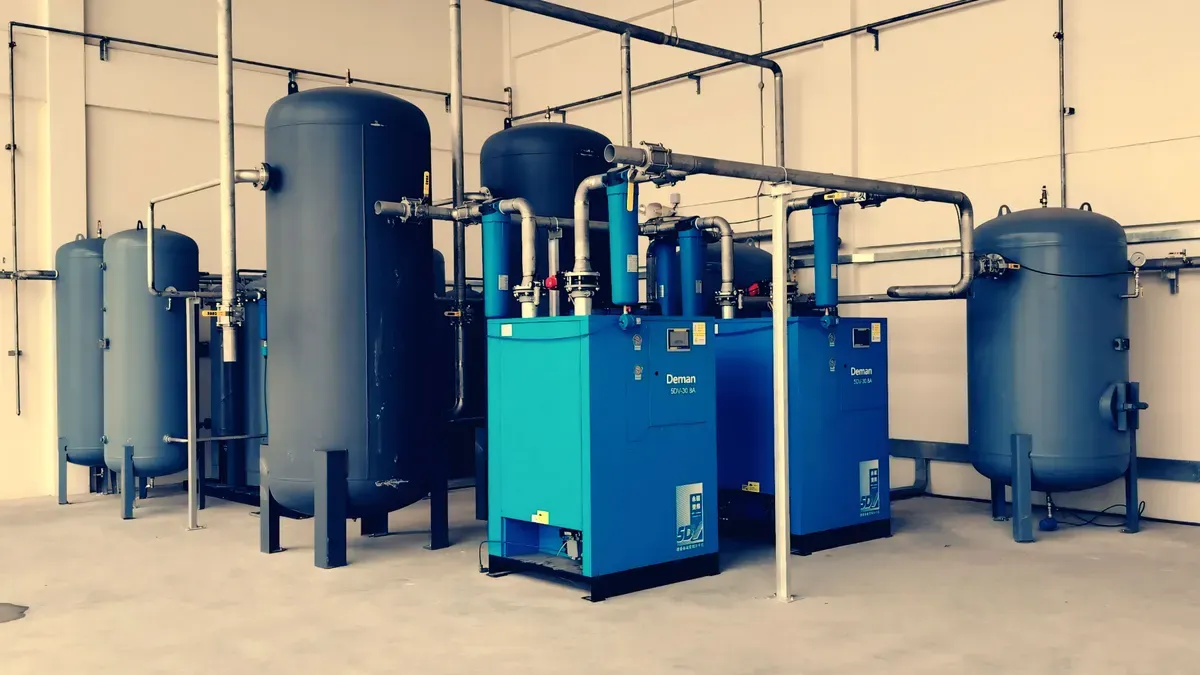
A good contractor gives you much more than just pipe installation. Comp-Air Ohio points out that a strong provider first looks at your facility needs and air demand. This review covers air usage, where equipment sits, production needs, air quality goals, and plans for future growth. The contractor then suggests a layout that works well, along with compressor connections, filtration, dryers, and accessories. Every choice is meant to lower pressure loss, make service easier, and keep air delivery steady.
Skilled suppliers also run compressed air audits before installation. These audits spot inefficiencies, leaks, pressure drops, and gaps between equipment capacity and real demand. The results help guide correct pipe sizing, layout fixes, and air treatment needs. Design should make airflow as good as possible and keep pressure drops low so your equipment runs at its best. Aircomo explains that longer straight runs create less turbulence than angled sections, and wide bends lower resistance. Fewer elbows mean better flow and real energy savings. Direct Air adds that custom layouts should match your production needs and the space you have.
Commissioning and Testing
Professional commissioning turns a finished installation into a system that actually works. Atlas Copco lays out the steps: clean and flush the pipeline, pressure test it, condition it with dry air or nitrogen, then commission it. Commissioning includes checking valves, sensors, and controls, plus operational testing over the required distances. A post-commissioning phase comes next, where the contractor watches and fine-tunes performance.
Testing should get just as much attention. Danmar Industries lists pressure and flow testing, leak and safety checks, and air quality testing against ISO 8573. The contractor should also confirm that pressure relief valves and safety switches work. Expect a full commissioning report that covers the tests done, the results, and any fixes made. Training your team on operation, monitoring, and maintenance completes the handover. These steps protect your investment and cut down on surprise shutdowns.
The material you pick affects how your system works for its whole life. Aluminum and galvanized iron (GI) each fit different situations. So compare them on performance, application fit, compliance, and cost before you decide.
Aluminum vs. GI Performance
GI starts with a real plus: the zinc coating greatly cuts corrosion compared with black iron, which is why Fluid Air Dynamics notes it stays a popular choice. That coating breaks down over time, however. As the zinc wears away, it can flake off inside the piping and cause blockages or fouling. Sharp flakes also become a safety concern when they blow out of air lines at high speed.
Aluminum acts differently. It does not rust; it forms a thin, stable oxide layer that keeps the inside diameter smooth and even, as MI Air explains. Fluid Air Dynamics reports that aluminum systems have grown in popularity over the last 10 to 15 years, and they run about three times lighter than iron piping. The performance gap shows up in pressure loss. Cmatic Control reports that standard GI networks suffer friction from rust scaling and drop 1.0 to 1.5 bar. Aluminum tubes with an internal roughness of 0.8 μm Ra or better keep system-wide pressure drops under 0.1 bar. Cmatic Control also notes that every 1 bar of pressure drop forces the compressor to run 7 to 8 percent harder.
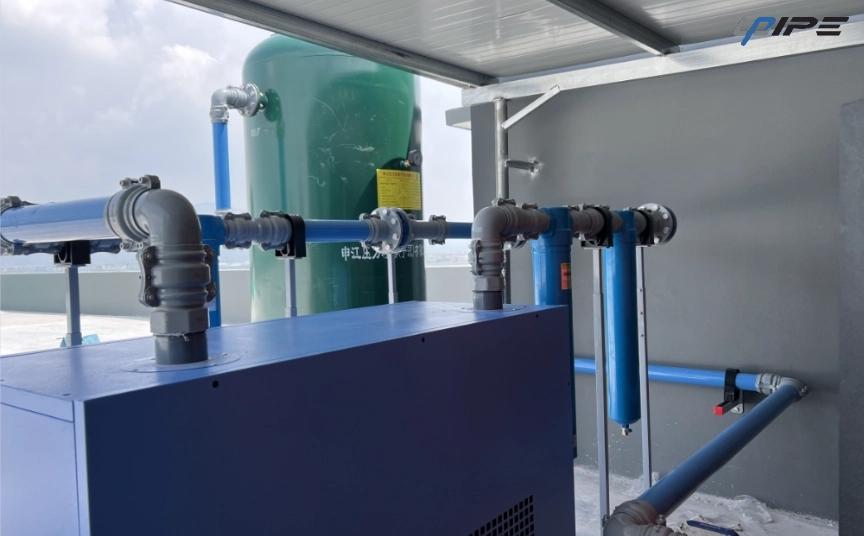
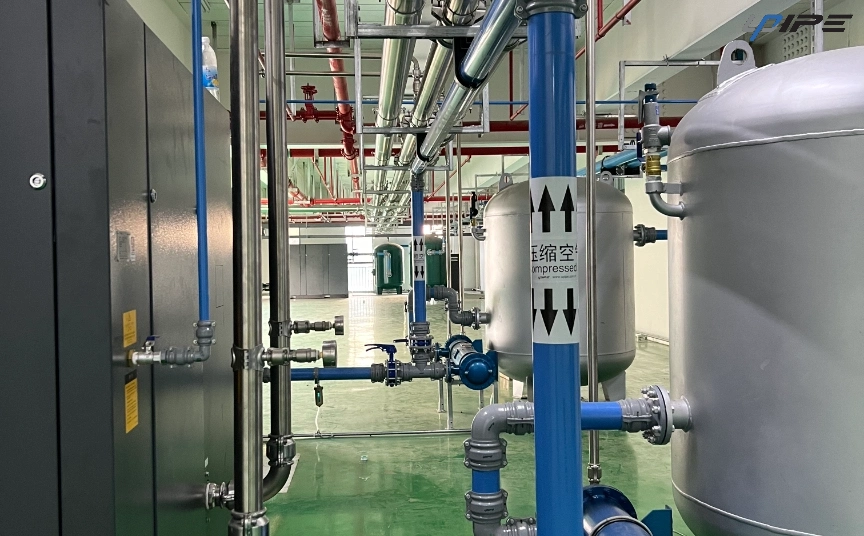
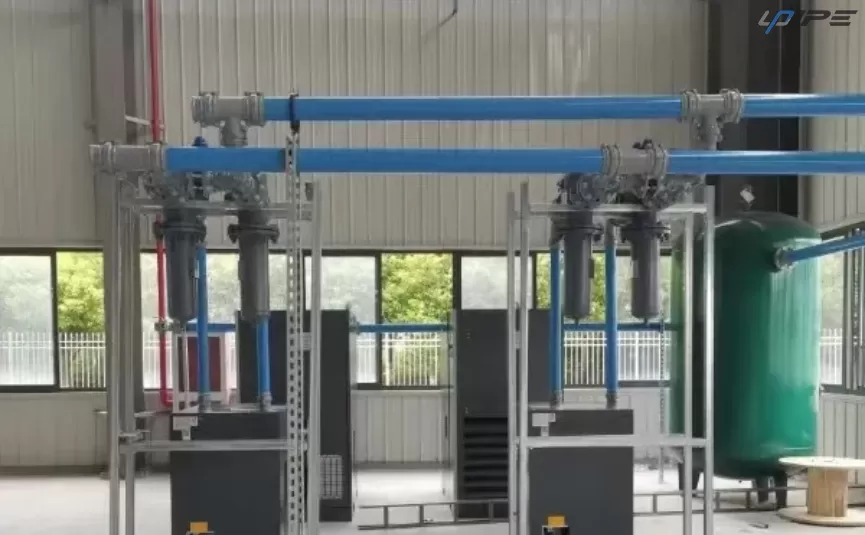
The Upipe Aluminum Pipe System shows how a modular aluminum solution works in practice. Precision-made fittings — 90° elbows, equal and reducing tees, pipe-to-pipe connectors, male and female connectors, flanges, 90° and 180° quick drops, and end caps — build a complete network. Ball valves and butterfly valves handle flow control, and a flowmeter helps monitor air consumption. Connections stay leak-free, installation moves fast, and you can expand the layout later without a major shutdown.
Compliance and Cost Fit
Both materials can meet industrial codes when you specify and install them correctly. Compliance depends on following the manufacturer's instructions and the listed pressure and temperature limits, as Atlas Copco advises. Some sectors carry stricter expectations: Atlas Copco notes that pharmaceutical facilities, hospitals, clean rooms, and laboratories usually call for SS304L or SS316L stainless steel. Match the material to your air quality class and your inspector's requirements, and keep the certificates on file.
Cost fit depends on how you count. Aluminum often carries a higher initial price, yet its smooth bore, low leak potential, and minimal maintenance tend to lower lifetime costs, according to Unipipe. GI usually wins on upfront price for simple, low-demand layouts. Durability ties the decision together: a material that resists corrosion and holds a stable bore protects pressure consistency and uptime for years.
Choosing the Right Contractor for Your Industry
Application Examples by Sector
The right piping option depends on your sector and your specific project needs. A factory with steady, high-volume demand often does well with a closed-loop ring main and smooth-bore aluminum piping. An automotive workshop has different needs, and Topring breaks the sector down by work area:
Body shop: paint work that needs a large amount of clean, dry air
Garage: tools that need high air volume, such as impact tools
Tire shop: air and nitrogen for inflation
Each of these areas needs a contractor who understands the air quality class and flow profile involved. A paint booth needs dry, clean air, while impact tools can handle different conditions. Ask your candidate to explain how the design serves your real processes, not a generic template. A firm with experience in your sector will spot demand patterns that a generalist misses.
Key Questions Before Signing
Put your questions in writing and get written answers. Ask what the design package covers: pipe sizing, air treatment, thermal expansion, and layout drawings. Confirm that commissioning and testing appear as line items, not assumptions. Request the material specifications, including pipe material, pressure rating, and connection technology. Ask how the contractor supports future expansion and modification, because production needs change. Finally, clarify warranty terms and what they cover. Haringa Compressor lists a life-time warranty for Infinity aluminum piping (pipes and fittings) and a 10 year guarantee for stainless steel piping, which shows how much terms can differ between systems.
A written proposal protects you at every stage. Compare answers side by side before you choose compressed air pipeline contractor finalists, and treat vague replies as a warning sign. Clear answers on scope, testing, materials, and warranty give you a fair basis for comparison.
Think about proven experience, engineering and design skills, safety and compliance, extra services, and the right materials before you pick compressed air pipeline contractor finalists. The right partner brings you long-term efficiency and reliability. The wrong one causes ongoing costs from pressure drops, leaks, and rework.
Your evaluation framework now covers the key points: references you check yourself, a written design package, commissioning and testing listed as line items, and a material that fits your air quality class and demand profile. Use it to compare candidates side by side.
Ask two or three qualified contractors for a site survey and a written proposal. Compare scope, testing, materials, and warranty terms. Then commit with confidence.
FAQ
What should you check first when you screen a compressed air pipeline contractor?
Begin with industrial references you can verify and a written safety record. Ask for pressure test records and material certificates. Make sure the firm can explain how it sizes pipes. A contractor who cannot walk you through the design logic will struggle when your system underperforms.
What belongs in a written design package?
Ask for pipe sizing calculations, air treatment specifications, thermal expansion provisions, and layout drawings. The package should also name the configuration, such as a closed-loop ring main. Treat any proposal without these documents as incomplete. You need the full package before you compare bids.
Does aluminum piping cost more than GI?
Aluminum often has a higher upfront price. Its smooth bore and low leak potential tend to lower lifetime costs, though. GI usually wins on initial price for simple, low-demand layouts. Match the material to your air quality class and demand profile, then compare total cost of ownership.
Why does pressure drop matter so much in material selection?
Standard GI networks can lose 1.0 to 1.5 bar through friction and rust scaling. Aluminum tubes with an internal roughness of 0.8 μm Ra or better keep system-wide pressure drops under 0.1 bar. Every 1 bar of pressure drop makes the compressor work 7 to 8 percent harder.
What warranty and expansion support should you confirm before signing?
Ask what the warranty covers and how long it lasts. Terms vary widely between systems. Confirm the contractor supports future changes, because production needs change. A modular system lets you expand the layout later without a major shutdown.
This website uses cookies to provide you with a safer and more personal experience. By accepting, you agree to the Cookie Policy and the use of cookies for advertising and analytics purposes.