Home > News > Blog > Which compressed air piping company offers quick technical support
# Blog
Which compressed air piping company offers quick technical support
2026-10-25
Share:
RapidAir Products, Air Services Company, and OTC Compressed Air Services offer the fastest technical support. Compare response times and availability to choose the right compressed air piping company.
RapidAir Products, Air Services Company, and OTC Compressed Air Services are known for fast technical support. AIRpipe USA is a good choice during business hours. You can judge speed in three ways: how fast they respond, when and how you can reach them, and how good the help is. A quick phone line means little if the technician cannot figure out your layout. This comparison shows how each compressed air piping company handles support. It also helps you pick the one that best cuts downtime for your operation.
Key Takeaways
Check three things: how quickly a company responds, when you can reach them, and if their help fixes problems.
Air Services Company and OTC Compressed Air Services give 24-hour help for emergencies.
Ask how many minutes a typical response takes. Also ask if the phone line reaches a trained technician.
Match support hours to your plant's schedule: all day and night for continuous operations, regular business hours for single shifts.
Pick a system that is quick to install and needs little upkeep. This will cut down on support calls.
Support Metrics at a Glance
Response Time and Availability
Support hours are very different across the compressed air piping company field. Air Services Company and OTC Compressed Air Services both give 24-hour support. RapidAir Products makes fast response a key part of its service model. AIRpipe USA works from 8am Eastern to 5pm Arizona time, which covers normal business hours for most North American operations.
You can reach some vendors any time for emergency service. One provider lists 24/7 availability for emergency service, with a phone line at 410-876-5141. That kind of always-on access matters when a line failure stops production at 2am. A failed joint or a dropped pressure reading can stop a whole shift. The faster you reach a technician, the faster you get air flow back.
This guarantee shows how some companies set up their support to cut downtime. You should check the real response window before you sign a contract. Ask whether the 24-hour line connects you to a technician or a call center. A call center can log a ticket. A technician can diagnose a problem. Those are very different levels of help. Published hours tell only part of the story. You also need to know how fast a technician responds once you call. A 24-hour hotline means little if the callback takes hours. Ask for a typical response time in minutes, not in promises.
Channels and Expertise
Support channels differ in depth as well as reach. Phone support is still the fastest path for most troubleshooting. Air Services Company publishes a contact line at (800) 323-8162. OTC Compressed Air Services lists its number at 866-468-9814. Email gives a written record for less urgent questions. Some vendors provide email contacts such as help@fixmycompressor.com and help@compressormaintenance.com. On-site help is the deepest level of support. One company lists a physical service address at 715 Corporate Center Ct Suite A, Westminster, MD 21157.
The table below sums up these metrics for a side-by-side view.
Vendor
Support Hours
Phone
Email
On-Site
Air Services Company
24-hour
(800) 323-8162
Not listed
Not listed
OTC Compressed Air Services
24-hour
866-468-9814
Not listed
Not listed
RapidAir Products
Rapid response emphasis
Not listed
Not listed
Not listed
AIRpipe USA
8am Eastern–5pm Arizona
Not listed
Not listed
Not listed
Technical expertise matters as much as channel availability. A phone line staffed by a generalist cannot solve a layout problem. You want a technician who understands pipe sizing, flow rates, and pressure drop. Ask each vendor how they train their support staff. Ask whether the same person who answers the phone can review your drawings. A strong support team can spot a sizing error before it becomes a costly rework. Depth of expertise also varies by product line. A vendor that sells and installs its own system can often answer questions faster than a reseller. That single-source model cuts handoffs between sales, engineering, and field service.
These metrics give you a neutral basis for comparing any compressed air piping company. They do not prove one vendor is better. They show where each one fits your operation's schedule and risk profile. A plant that runs three shifts needs different coverage than a shop that closes at 5pm.
RapidAir Products: Fast Response Support
Technical Performance and Application Fit
RapidAir Products uses a single-source model. One team handles your quote, your order processing, and your installation. This setup cuts down on support handoffs. You do not go back and forth between a sales desk and a separate engineering group when a question comes up. The same organization that sized your system can answer questions about it later.
The product line covers common industrial compressed air layouts:
FastPipe is made in the USA and serves industrial and commercial applications.
The Vairify breathing air system keeps air clean in paint booths and sends filter-replacement alerts to support OSHA compliance.
Pro-press-style fittings carry a lifetime warranty for reliable, low-maintenance connections.
Flexibility and durability give these systems an edge over copper or black pipe. That edge shows up in lower installation and lifecycle costs and fewer maintenance needs.
Hobbyist and industrial applications; bendable, holds shape
Compliance, Cost, and Support Value
Compliance support adds real value to the package. The Vairify system targets paint booth air quality and flags filter changes. This alert function helps you stay ahead of OSHA requirements without chasing paperwork.
Cost and support value connect here. A system that installs cleanly and needs little upkeep generates fewer calls in the first place. The lifetime warranty on the pro-press-style fittings backs that low-maintenance promise. You get fast response when you need it, and you need it less often. For a plant weighing support speed against budget, that combination deserves a close look.
Smooth, corrosion-resistant bore; preferred for most plant air distribution
Schedule 40 carbon steel / galvanized steel
Widely used at 100–125 PSI
Corrosion and scale narrow the bore over time, increasing friction
Stainless steel
Acceptable where contamination avoidance is required
Cost premium justified in food, pharmaceutical, and textile plants
PVC
OSHA explicitly prohibits PVC for compressed air transport
Brittle failure can shatter and eject plastic fragments
Other polymer systems
Must be specifically approved for compressed air and comply with building codes
Only compliant polymers permitted
A technician on a 24-hour line can walk you through this table at any hour. That access helps when you face a material decision under deadline.
Sizing mistakes drive up cost, and support staff can catch them early. A CAGI case study shows the stakes: a 4" pipe serving 2,909 SCFM produced a 10 PSI pressure drop, which forced a full replacement with 6" pipe. Peak-demand sizing would have avoided that expense. Common mistakes include sizing for average rather than peak demand, ignoring equivalent lengths for fittings, and failing to plan for future expansion. Upsizing at installation costs a little more. Field corrections cost far more.
A 24-hour help line gives you a fast path to answers on these issues. You can call at night and still reach someone who understands pressure stabilization and operating costs.
Air quality ties directly to compliance. As one industry note puts it:
Air quality is a critical factor: contaminants such as moisture and debris can compromise product integrity and damage equipment. Piping solutions that support clean, dry air delivery help keep processes compliant and efficient, supporting long-term system reliability and performance optimization.
Air Services Company fits operations that run around the clock and want material guidance on demand. Weigh the always-on access against your own downtime risk and budget.
OTC Compressed Air Services: Managed Support
Technical Performance and Application Fit
OTC Compressed Air Services focuses its support on well-trained people. The team has over 300 factory-trained technicians, and each one gets another 300+ hours of OTC training. That depth helps when you need a real diagnosis, not just a ticket number. Technicians use factory OEM parts, so your compressed air system stays at peak efficiency after a repair.
The certification structure shows you clearly who comes to your site. Service leaders hold OSHA 30 certification. Service technicians hold OSHA 10 or above. Specialized staff also carry TWIC and MSHA training for compliance and safety work. All team members finish Air Academy in-house factory certified training.
Role / Category
Certification or Training
Service Leaders
OSHA 30 certified
Service Technicians
OSHA 10 or above certified
Specialized Qualifications
TWIC and MSHA training (plus others) for compliance and safety
All team members
Air Academy in-house factory certified training
This layered training suits plants that want one accountable partner for installation, service, and safety compliance. You get technicians who understand both the piping layout and the site rules that apply to it.
Compliance, Cost, and Support Value
Managed support changes how you look at cost. OTC assigns dedicated technicians to customer service agreements. The same people learn your system over time, so they spend less time relearning your layout on each visit. Factory-trained technicians are available across the United States, and the company offers 24/7/365 emergency service.
That always-on coverage is worth a lot to operations that cannot stop. A failed drop or a leaking joint at an odd hour still gets a response. The staff are described as experts in compressed air, trained and certified in the latest technology and best practices. You can rely on that expertise for material questions, pressure stabilization, and safety compliance.
Weigh the managed model against your own downtime risk and budget. A service agreement with dedicated technicians suits plants that run continuous shifts and want predictable support. A smaller shop with daytime hours may find a lighter support model easier to justify. OTC fits best where uptime is the top priority and you want certified people on call at any hour.
Upipe Aluminum Pipe System: Support-Light by Design
Fast, Clean Installation That Cuts Downtime
The Upipe Aluminum Pipe System starts with pure aluminum and no recycled material. Every pipe comes precisely cut at both ends with clean inner surfaces. A thicker wall design runs across all models. On DN40 and above, pre-treated raised rings save time during on-site installation. Packaging adds a non-woven fabric lining, outer plastic sealing, and sealed ends to keep contamination out.
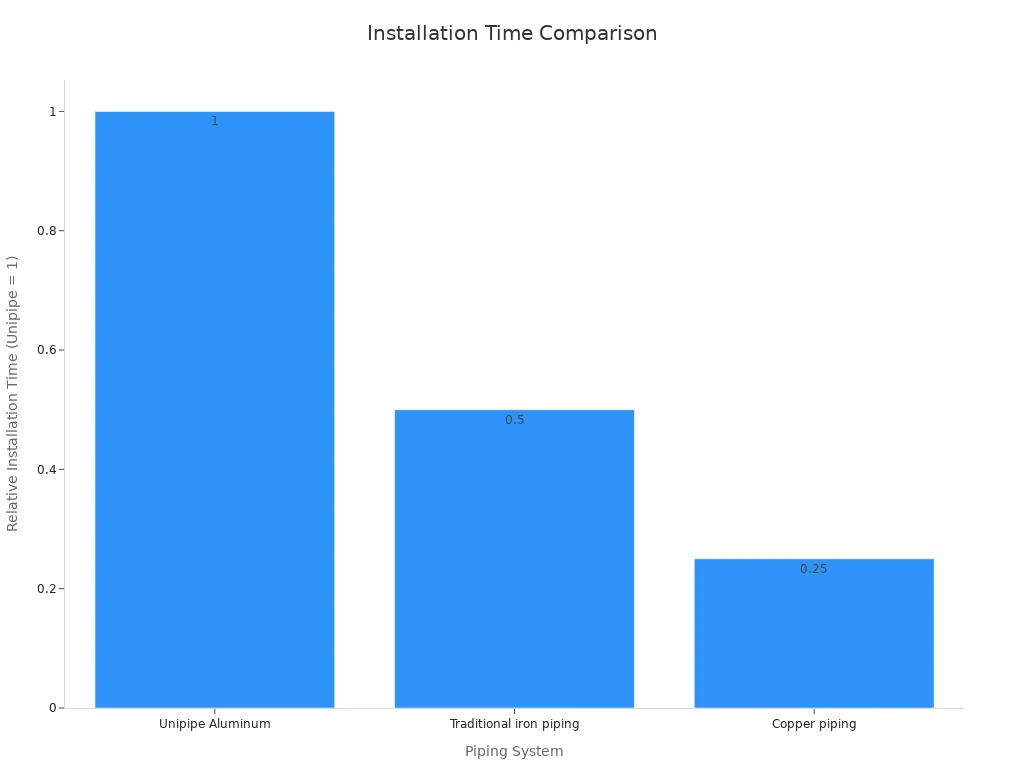
Installation speed is where this system really pays off. You can cut installation time by 40–60% compared to traditional piping methods. Iron piping takes about half the time of Upipe, and copper piping takes about a quarter. That gap matters when a line is down and every hour costs production.
Reliability That Reduces Support Calls
Fewer problems mean fewer calls. Upipe builds reliability into each part:
Connectors use an integrated molding process, so the bolt and body share equal strength for higher pressure resistance.
Sealing rubber is imported from Thailand and resists leaks from vibration or improper installation.
Tees, elbows, and quick drops use flow-directing shapes that add structural strength and reduce pressure loss.
Quick drops have reinforcement ribs to prevent breakage from stress imbalance.
Passive locking accessories use high-strength materials to prevent fracture.
A gooseneck design stops condensate from flowing down into the pipes and protects your equipment.
Ball valves use integrated aluminum alloy for long-term stability.
All pipe clamps include anti-vibration features.
Quick drops also arrive ready to use on demand, which saves production time. The foolproof, multi-surface sealing removes leakage risk and keeps installation simple. You get a system that installs fast and needs little upkeep, so your team spends less time chasing support and more time running air.
Choosing the Right Compressed Air Piping Company
Match Support Speed to Downtime Risk
Support speed only matters when you think about what a stoppage costs you. Start with your downtime risk. A plant that runs three shifts loses money the moment air pressure drops. A shop that closes at 5pm can wait until morning for most answers. Compare your operation to that reality before you look at vendors.
Next, weigh the three support metrics together. Response time tells you how fast help arrives. Availability tells you when you can reach that help. Quality of help tells you whether the person on the line can really solve your problem. A 24-hour hotline run by a call center scores well on availability and poorly on quality. A business-hours line staffed by engineers may serve you better if your failures rarely happen at night.
Budget comes into play here. Always-on coverage usually costs more, whether through a service agreement or a premium product line. Match that cost to your real risk. If a line failure costs you a full shift of production, round-the-clock support is worth the money. If your operation runs daytime hours only, you may pay for coverage you never use.
Questions to Ask Before You Choose
Bring a short list of questions to every sales call. The answers separate a fast compressed air piping company from one that only claims to be fast.
Are support hours 24/7 or business-hours only?
Is on-site help available, and how fast can a technician reach my site?
What is the typical response time once I call?
Does the person answering the phone have technical training, or do they only log tickets?
Can the same team review my drawings and my layout?
Write down each answer and compare them side by side. Vague promises about "rapid response" tell you little. A named response window tells you a lot.
AIRpipe USA fits a specific profile in this comparison. Its support runs from 8am Eastern to 5pm Arizona time. That schedule suits operations that do not run around the clock. A single-shift shop, a facility with planned maintenance windows, or a plant with a backup compressor can plan around business hours. For those operations, a business-hours compressed air piping company keeps support costs down without adding real risk.
The right choice comes down to fit. Weigh response time, availability, and quality of help against your downtime risk and your budget. Then pick the vendor whose support model matches the way your plant actually runs.
RapidAir Products, Air Services Company, and OTC Compressed Air Services give you the fastest ways to get help. Air Services Company and OTC both have 24-hour phone lines. RapidAir Products centers its whole approach on responding fast. The Upipe Aluminum Pipe System goes a different way. It goes in quickly and needs little care, so you call for help less often.
Think about three things before you sign: how fast they respond, when you can reach them, and how good the help is. Compare those with your risk of downtime and your budget. A plant that runs all day and night needs a compressed air piping company with support at all hours. A shop with one shift can save money with business-hours support.
Choose the vendor whose support hours match the hours you run. Then make sure the person on the line can really fix your problem.
FAQ
Which companies offer 24-hour compressed air piping support?
Air Services Company and OTC Compressed Air Services both have support lines that run 24 hours a day. RapidAir Products makes fast response the center of how it serves customers. AIRpipe USA only covers business hours, from 8am Eastern to 5pm Arizona time. Make sure these hours fit the schedule your plant actually runs.
How do I verify a vendor's response time before I buy?
Ask for a typical response window in minutes, not a vague promise. Find out if the phone line reaches a trained technician or a call center that only logs tickets. Write down each answer and compare vendors side by side.
Does on-site technical help matter for piping projects?
Yes, for larger installations. A technician on site can catch sizing errors and layout problems that a phone call might miss. Ask each vendor whether on-site help is available and how fast a technician can reach your facility.
Can business-hours support work for my plant?
It can, if your operation does not run around the clock. A single-shift shop or a facility with planned maintenance windows can schedule work during normal hours. Plants with continuous production should weigh round-the-clock coverage against the extra cost.
What reduces the need for support calls in the first place?
Clean installation and low-maintenance parts cut future problems. The Upipe Aluminum Pipe System installs quickly and uses sealed connectors, anti-vibration clamps, and gooseneck condensate protection. Fewer failures mean fewer calls to any support line.
This website uses cookies to provide you with a safer and more personal experience. By accepting, you agree to the Cookie Policy and the use of cookies for advertising and analytics purposes.